Given the wide spectrum of potential causes for TMA in cancer patients, the aim of this review is to gather the vast information available. For each entity, pathophysiological mechanisms, clinical features, therapeutic approaches and prognosis will be covered. There are some case reports with the use of rituximab (an anti-CD20 monoclonal antibody), and a few studies about complement inhibition (such as eculizumab, a monoclonal antibody against complement factor C5) in specific situations 6, 11, 12, 13. There were no group data reports describing definite evidence for a causal association with TMA. Once STEC is in the intestines, it attaches to the epithelium where it produces Shiga toxin which translocates through to the blood stream.
What Are The Causes And Symptoms Of Thrombotic Microangiopathy?
Two additional patients had evidence supporting a probable association of the suspected drug with their episode of TMA (one attributed to quinine, the other to trimethoprim-sulfamethoxazole). Samples from patients in the Oklahoma Registry are not included in these data. Although the mechanisms of endothelial injury during DITMA still remain unknown; immune-mediated mechanisms or dose-dependent and cumulative toxicity are implied (11). The hypothesis is based on the observation of the timing of TMA occurrence, the pattern of disease, the exclusion of a better explanation thorough investigation. DITMA suspicion is ampilified by TMA resolution when the drug is withdrawn or recurrent endothelial injury during re-exposure to the drug.

CAPS (catastrophic Antiphospholipid Antibody Syndrome) 📖
Variants in Thrombomodulin (THBD), a transmembrane glycoprotein with anticoagulant properties and a negative regulator of the complement system on vascular endothelial cells, may lead to a TMA. If not identified and treated in a timely manner, prognosis is the worst in patients with Factor H mutations, with 60%-70% reaching kidney failure within a year of disease onset. Patients with CD46 mutations have a better prognosis, with approximately 80% remaining dialysis-independent.
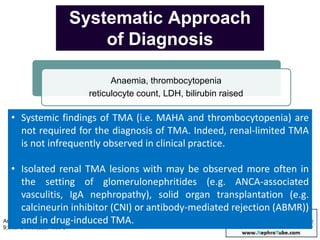
However, any or all of the MAHA features can be absent, especially in renal-limited disease, and this is when a high index of suspicion is called for. The presence or absence of schistocytes is a particularly debatable disease marker. One published report of gemcitabine-mediated TMA described the clinical features of an acute, immune-mediated mechanism;(22) the other 5 patients had the clinical features of a chronic, dose-dependent toxic mechanism. The first reported case of monoclonal antibody-induced TMA described a patient treated with anti-T cell monoclonal antibody muromonab-CD3 (OKT3) (65). Emicizumab, a monoclonal antibody used in Hemophilia A, co-administered with high doses of activated prothrombin complex concentrate (aPCC) has been linked with TMA in three patients (66).
Table 2 Summary Case Report 1 And 2

The absence of genetic abnormalities in most patients does not exclude participation of complement in the pathogenesis of DITMA and other secondary TMAs. In fact, the activated procoagulant and proinflammatory endothelial cell phenotype characteristic of DITMA can induce a non-specific activation of complement, which in turn can promote and aggravate TMA (Duineveld and Wetzels, 2019; Frémeaux-Bacchi et al., 2019). In severe hypertension, thrombotic microangiopathy may result from endothelial cell damage. Distinguishing between primary thrombotic microangiopathy with subsequent hypertension, and malignant hypertension with subsequent thrombotic microangiopathy, is difficult. As with aTTP, patients with cTTP (Upshaw–Schulman syndrome) require plasmapheresis—possibly followed by long-term treatment with repetitive plasma infusions—if they sustain organ damage. Asymptomatic patients with no signs of hemolysis and normal platelet counts may undergo watchful waiting without plasma infusions (15).

MAHA is caused by red blood cell fragmentation in the microvasculature, with schistocytes seen on peripheral blood film. Lactate dehydrogenase (LDH) is raised due to tissue ischemia and cell lysis. Low plasma haptoglobin is a marker of haemolysis as it binds to free haemoglobin and the complex is cleared by macrophages. Coombs test is generally negative apart from in pneumococcal haemolytic uraemic syndrome (Figure 1). Coagulation screen is normal in TMA in contrast to elevated PT and aPTT and low fibrinogen in disseminated intravascular coagulation. Methylmalonic aciduria and homocystinuria, cobalamin C type (MMACHC), or simply cobalamin C disease, is ultra-rare, but is the most common genetic type of functional B12 deficiency.
Clinical Presentation And Patient Evaluation
- A thorough evaluation is essential, in order to identify atypical signs and symptoms that allow the recognition of an indolent hematologic disease.
- Jodele et al. described 13 patients developing TMA after high-dose chemotherapy and autologous stem cell transplantation for neuroblastoma (12 patients receiving carboplatin/etoposide/melphalan and one cyclophosphamide/thiotepa) (38).
- The mechanisms of drug-induced endothelial damage are heterogenous and not completely understood.
- An autopsy-based study showed that patients with acute GVHD had a higher probability of developing TMA, independently of CNI and mTORI use 97.
Additionally, in the era of PE for aHUS, treatment was routinely withdrawn with only a proportion relapsing and requiring ongoing PE. Eculizumab has changed the natural history of the disease and many patients who would previously have reached ESRF despite plasma exchange may remain dialysis free and susceptible to disease relapse. Diacylglycerol Kinase ε (DGKE)-TMA manifests in infants with progressive CKD and kidney failure. Loss-of-function DGKE mutation can cause endothelial damage with activation of protein kinase C, upregulation of prothrombotic factors, downregulation of the VEGF receptor, podocyte injury, and TMA.

PE is a contentious issue due to concerns that infusing plasma containing more anti‐T IgM will worsen the disease state. There are case studies using washed/plasma reduced blood components such as albumin with PE with good results which is thought to be due to removal of host anti‐T IgM and the neuraminidase.71 Mortality remains high at up to 10%. Before the development of complement inhibitors PE was the main treatment for complement‐mediated aHUS. The removal of FH antibodies and overactive complement components with replacement of defective complement regulatory proteins made PE a logical treatment. PE is started, in adults, presenting with a TMA, while waiting for the ADAMTS13 activity level to exclude TTP. In children, TTP is rare, and PE has a more side effects, therefore, complement inhibitors are first line.47 PE remains the only treatment in countries where access to complement inhibitors is restricted due to cost.
Podcast: Thrombotic Microangiopathy (TMA) – With Dr Manish Saha
Eight of the 18 patients with documented quinine-dependent antibodies also had a history of systemic symptoms with previous quinine exposures. ADAMTS13 activity was measured on 16 of the 19 patients; none had severely deficient ADAMTS13 activity (mean, 65%; range, 25–100%). Further studies are needed to understand mechanisms of drugs-related damage, the role of complement activation and the efficacy of TPE, RTX and anti-complement therapy in DITMA. We performed a literature review in order to understand the extent of the complement activation searching both for decreased serum value of complement proteins and complement deposition in kidney biopsy.
Cancer Drug-induced TMA
Other people with TTP develop a type of autoimmune disorder that interferes with the activity of the ADAMTS13 gene. And “microangiopathy” is a medical situation affecting small blood vessels — specifically capillaries and arterioles. So TMA is a condition in which blood clots have formed in those blood vessels. Thrombotic microangiopathy (TMA) is a rare but potentially life threatening condition that affects the body’s small blood vessels. However, the presence of diarrhea is not sufficient to exclude other forms of TMA as ~ 30 – 40% of aHUS and TTP cases involve gastrointestinal symptoms, including bloody diarrhea 19, 20. A city with a population of 1 million will average only about 11 cases in a given year.
Gemcitabine

The most common form is HUS following infection with Shiga toxin–producing Escherichia coli (STEC), which is typically accompanied by bloody diarrhea (table 1). This form is called EHEC-HUS (enterohemorrhagic E. coli, EHEC) or STEC-HUS. HUS following a respiratory infection with Streptococcus pneumoniae (SP-HUS) is very rare.
These three isomers are significantly more active as hallucinogenic drugs, and have consequently been placed onto the illegal drug schedules in some countries such as the Netherlands and Japan. The other three isomers TMA-3, TMA-4 and TMA-5 are not known to have been used as recreational drugs to any great extent, and remain obscure scientific curiosities. Trimethoxyamphetamine-2, a psychedelic amphetamine and stimulant first synthesised by Alexander Shulgin. An uncommon compound of similar activity to other psychedelic amphetamines. These three isomers are significantly more active as hallucinogenic drugs, and have consequently been placed onto the illegal drug schedules in some countries such as Japan. MA, TM, and FA contributed to data collection and performed the research.
The mechanism is direct endothelial injury by virus with platelet aggregation, generation of thrombin, development of ADAMTS13 inhibitors, and complement activation. The mutations reported as “pathogenic” or “likely pathogenic” are known to cause dysregulation of complement activation. However, less than 50% of the genetically identified variants have a known functional consequence.
Associated Data
Some authors defend that mucin production may exert a direct injury in the tumoral endothelial cells. Microvascular tumor emboli, procoagulants produced by tumor cells and impaired fibrinolysis have also been implicated 34,89,139,141,143. If patients present atypical clinical features of TMA or fail to respond to treatments for idiopathic TMA, some authors recommend searching for systemic malignancy, after excluding other secondary causes 14,141,143,144. Besides the usual TMA workup, these patients require an active search for infections whenever sepsis is a possibility 91. Mutations in complement proteins and anti-H factor autoantibodies should be investigated in selected patients 107. GVHD is an epithelial cell disease mostly affecting the gastrointestinal tract, skin and liver, that has been identified as a major risk factor for HSCT-TMA 8,94, 95, 96, 97.